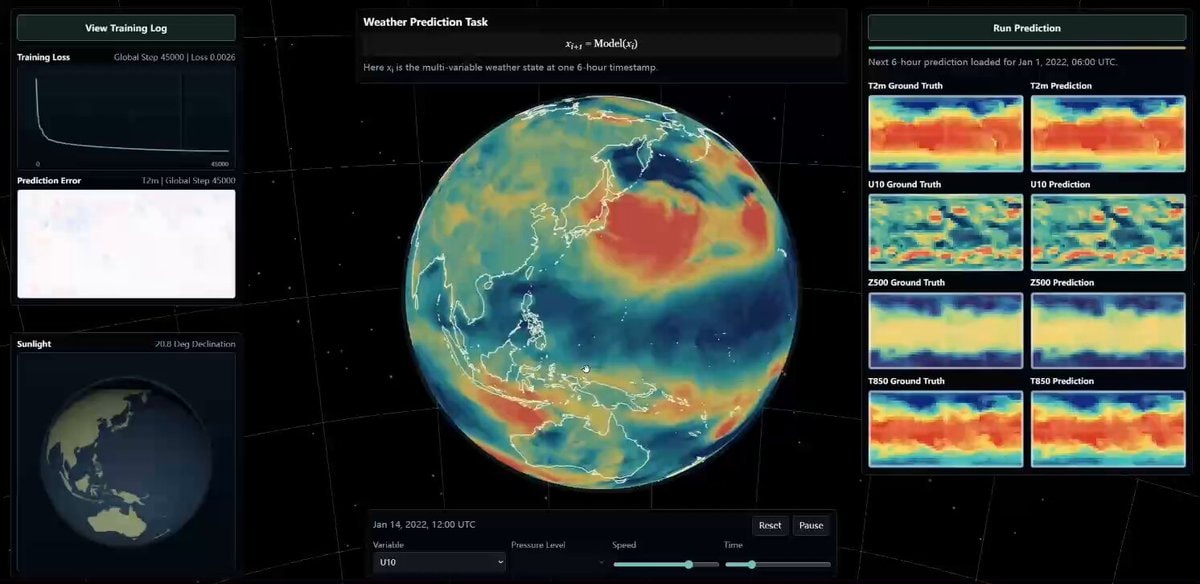
Atria Dawn Preview weather prediction demo
What if completion didn't mean the model claiming victory, but the output actually surviving a check? That's the whole premise behind Atria Dawn Preview, a new Chinese AI agent from AtriaASI that takes a research question and hands back something you can verify against real evidence. So I put it to work: an interactive weather-prediction demo, global forecasts at six-hour steps, with accuracy baked in. What came back was a spinning 3D globe loaded with live weather data, a loss curve updating in real time, and predictions parked right beside ground truth for temperature, wind, geopotential and T850. You can drag through early 2022 and flip between what the model called and what actually happened, frame by frame. Verification isn't bolted on afterward. Error maps refresh while training runs, so you're watching the thing genuinely converge, loss sliding down to roughly 0.003, instead of taking its word for it. One catch: the first training steps are visibly noisy, and you have to give it time to settle. Under the hood, reasoning is kept separate from a harness that carries the goals, state, permissions and error recovery. Training draws on task trajectories that were verified externally, failures included, to build capabilities that transfer between jobs. There's a 256K context window, and it plugs into Anthropic- and OpenAI-style APIs through clients like Claude Code or Codex CLI. But the backstory is the genuinely interesting part. Roughly 70% of the R&D team is university students, PhD, master's and undergrad level, hailing from places like Fudan University, Renmin University of China, Peking University and Shanghai Jiao Tong University. Young researchers building a tool for doing research. That's a setup worth staring at.