Bhagavad Gita
"The Song of God"
Vyāsa
Übersicht
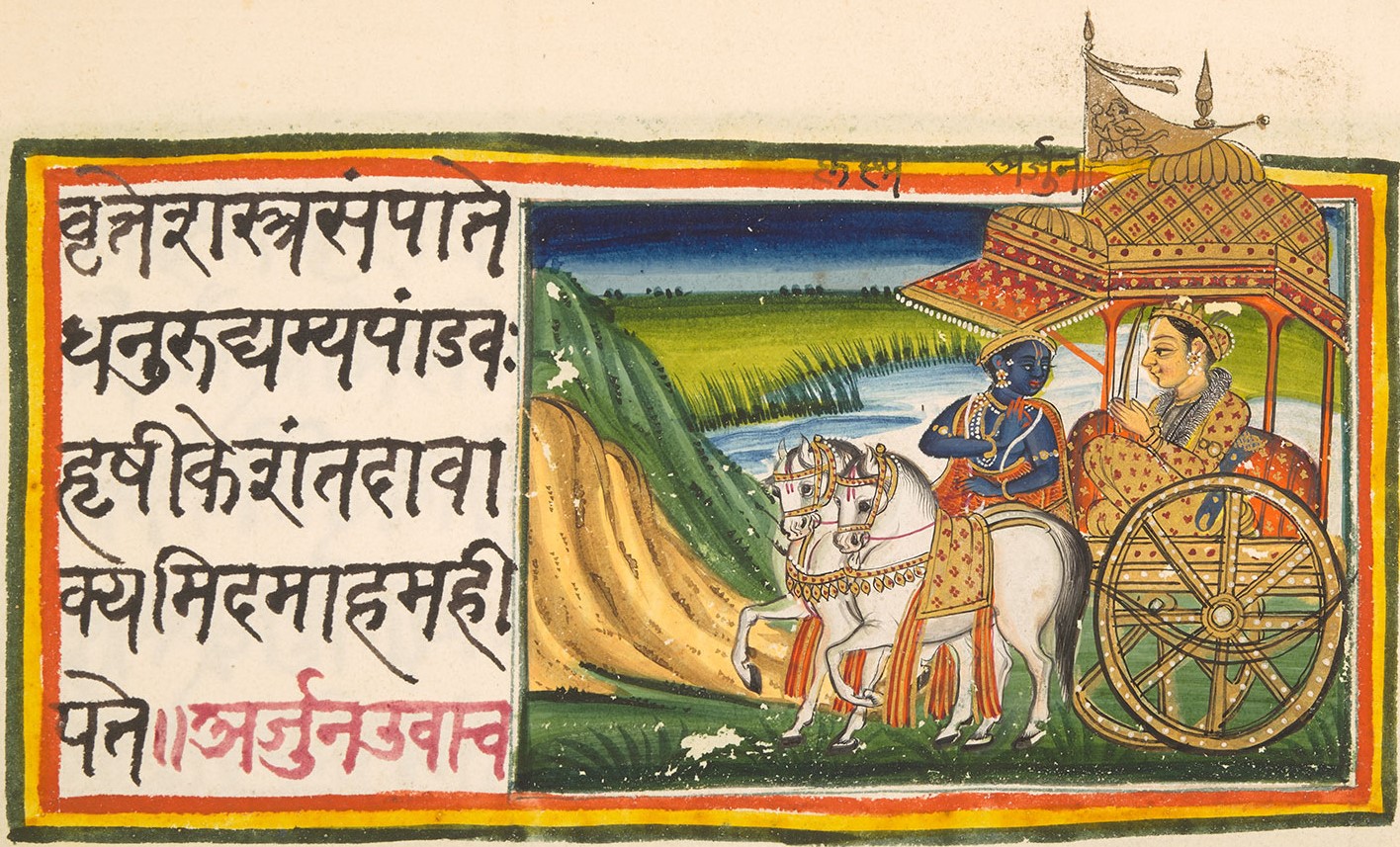
The battlefield of Kurukshetra lies silent before the clash, save for the voice of a warrior prince trembling with dread. Arjuna drops his bow, overwhelmed by the sight of teachers and kin arrayed against him in the opposing ranks. His charioteer, Krishna, steps forward not as a mere guide but as the Supreme Divine Personality to untangle the knot of Arjuna's grief. Over eighteen chapters, this dialogue dismantles the fear of death by explaining the eternal nature of the soul while demanding that duty be performed without attachment to the fruits of action.
Composed in Sanskrit between the fifth and second centuries BCE, the text crystallized into its final form sometime between the second century BCE and the first century CE. The first English translation appeared in 1785 when Charles Wilkins published The Bhagavad-Gita; or, Dialogues of Kreeshna and Arjoon. Since then, hundreds of versions have emerged, though the edition titled Bhagavad-Gita As It Is by A. C. Bhaktivedanta Swami Prabhupada stands out as the most widely distributed, selling an estimated twenty-three million copies globally.
Modern readers find its relevance extending far beyond ancient theology into psychology and leadership studies. Mahatma Gandhi cited the work as his spiritual bible, while American transcendentalists like Ralph Waldo Emerson and Henry David Thoreau drew heavily from its verses. In recent years, the text has sparked viral moments ranging from a Pakistani Hindu woman reading it aloud in Urdu on a beach to the British Prime Minister receiving a copy in Parliament.
Schlagwörter
Quellen
Buchinfo
- Autor
- Vyāsa
- Sprache
- Sanskrit
- Autor
- Vyāsa
- Sprache
- Sanskrit
- Verses
- 700
- Composition period
- 5th–2nd century BCE
- First English translation
- 1785 by Charles Wilkins
- Part of
- Mahabharata (Bhishma Parva, chapters 23–40)
Der Community beitreten
Fans diskutieren