Codex Atlanticus
Leonardo da Vinci
Übersicht
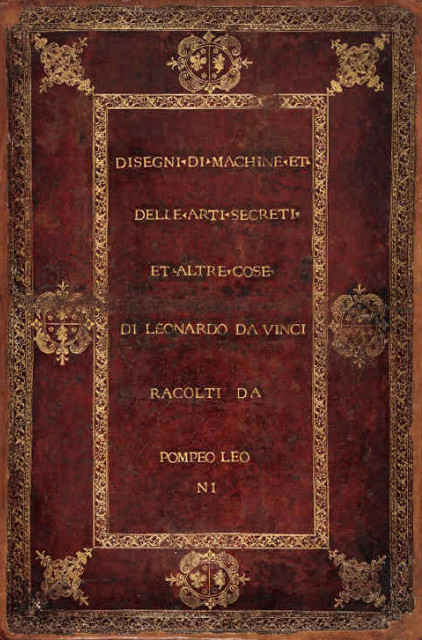
Leonardo da Vinci never saw his thoughts bound into a single volume during his lifetime. The massive collection known today as the Codex Atlanticus emerged decades after his death when sculptor Pompeo Leoni cut up original notebooks to create a uniform set of twelve volumes. These 1,119 leaves span forty-one years of work from 1478 to 1519 and measure roughly 65 by 44 centimeters. Leoni assembled the sheets between 1582 and 1590 to preserve Leonardo's legacy, though this process scattered the original chronological order of the artist's ideas.
The manuscript functions as an encyclopedia of Renaissance curiosity rather than a linear narrative. It contains thousands of pages filled with mirror script text alongside intricate ink drawings that cover engineering, flight, hydraulics, military technology, and anatomy. Designs for flying machines sit next to studies of water flow and sketches of musical instruments. This eclectic mix reflects a mind that refused to separate art from science or theory from practice.
Cardinal Federico Borromeo acquired the collection in the early 17th century and donated it to the Biblioteca Ambrosiana in Milan in 1637. The library has kept the fragile original there ever since. Modern access began with a limited facsimile edition produced by Giunti Editore between 1973 and 1975. A digital version launched online in 2009, and a major interactive project called the Leonardotheka aims to virtually reunite the dismembered sheets in their original logical sequence.
Schlagwörter
Quellen
Buchinfo
- Autor
- Leonardo da Vinci
- Herausgeber
- Giunti Editore
- Veröffentlicht
- 1973
- Seiten
- 2238
- Sprache
- Italian
- Autor
- Leonardo da Vinci
- Sprache
- Italian
- Number of leaves
- 1,119
- Leaf size
- 65 × 44 cm
- Date range
- 1478–1519
- Compiled by
- Pompeo Leoni (c. 1582–1590)
- Standort
- Biblioteca Ambrosiana, Milan
- First facsimile edition
- 1973–1975 (Giunti Editore)
- Digital edition
- 2009
Der Community beitreten
Fans diskutieren