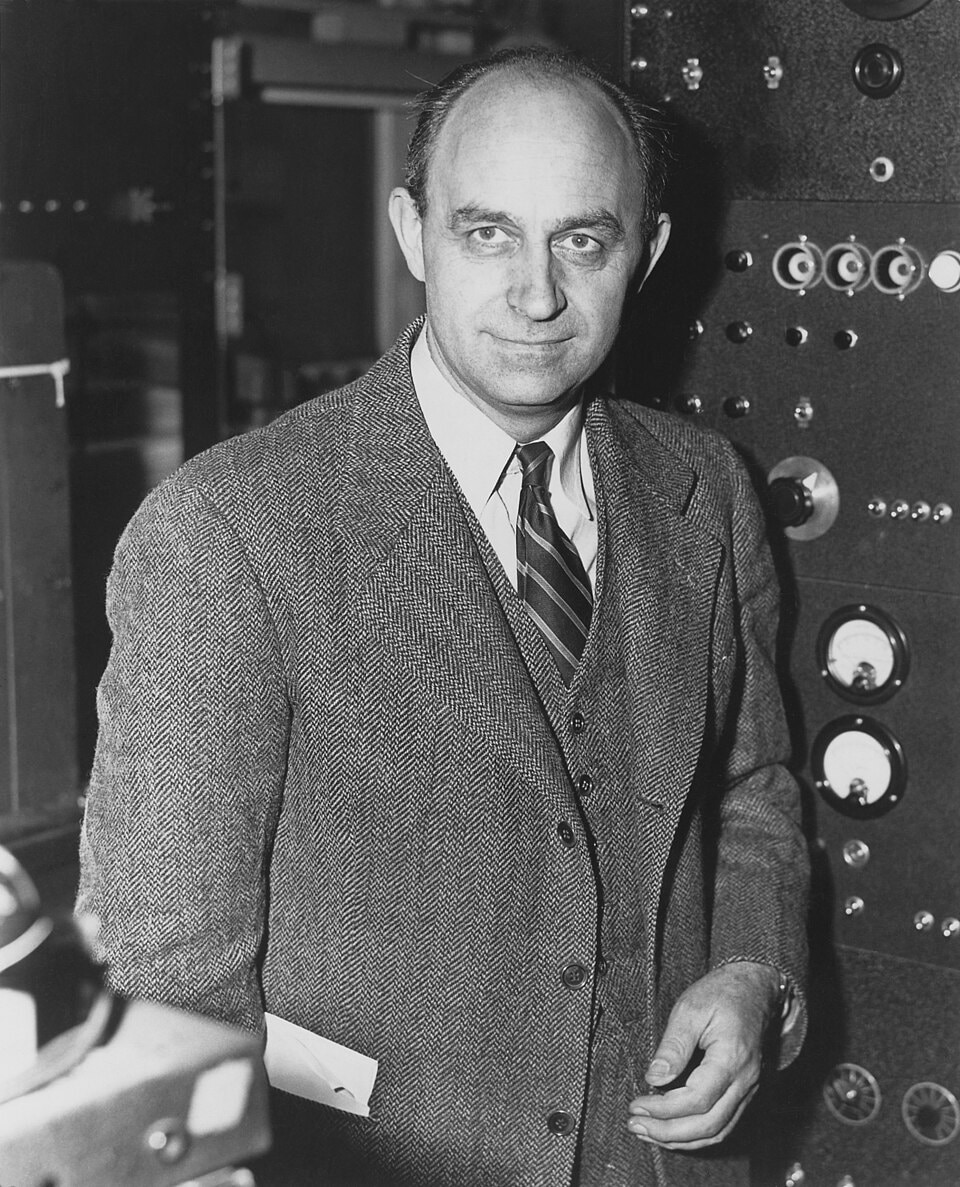
Enrico Fermi
 Italy
Italyphysicist•theoretical physicist•nuclear physicist
Geburtstag
September 29, 1901
Sternzeichen
Libra
Geburtsort
Rome, Italy
Alter
Gestorben mit 53
Größe
5 ft 9 in (1.75 m)
Über
Enrico Fermi was an Italian-American physicist widely regarded as one of the most brilliant scientists of the 20th century. He is best known for building the world's first artificial nuclear reactor, Chicago Pile-1, and for his pivotal role in the Manhattan Project. Fermi won the 1938 Nobel Prize in Physics for his demonstrations of new radioactive elements produced by neutron irradiation and for discovering nuclear reactions caused by slow neutrons. His work laid the foundation for the nuclear age, and he is celebrated for his rare mastery of both theoretical and experimental physics.
Fermi's contributions span multiple fields. He formulated the Fermi-Dirac statistics, which describe particles called fermions, and developed a theory of beta decay that postulated the existence of the neutrino. His discovery that slow neutrons are more effective in nuclear reactions revolutionized nuclear physics. After emigrating to the United States in 1938, he joined the Manhattan Project, where he led the team that achieved the first self-sustaining nuclear chain reaction on December 2, 1942. Today, his legacy is honored through the Fermi National Accelerator Laboratory, the Enrico Fermi Award, and the Fermi Paradox, which stems from a casual question he posed about extraterrestrial life.
Frühes Leben & Hintergrund
Fermi wurde in Rom als Sohn von Alberto Fermi, einem leitenden Inspektor im Kommunikationsministerium, und Ida de Gattis, einer Lehrerin, geboren. Sein frühes Leben war von einer Tragödie geprägt, als sein älterer Bruder Giulio 1915 plötzlich an einem Halsabszess starb. Der Verlust trieb ihn noch tiefer in sein Studium. Er entdeckte seine Leidenschaft für Physik und Mathematik, indem er alte Bücher von einem Marktstand auf dem Campo de' Fiori las und sich selbst komplexe Konzepte beibrachte. Mit 14 Jahren entwarf er bereits kleine Elektromotoren und studierte Abhandlungen über analytische Mechanik.
Fermi fand einen Seelenverwandten in seinem Freund Enrico Persico, mit dem er stundenlang über Physikprobleme diskutierte. Nach hervorragenden Studienleistungen erhielt er ein Stipendium für die angesehene Scuola Normale Superiore in Pisa. Er schloss sein Grundstudium 1922 ab und promovierte 1923 in Physik an der Universität Pisa. Seine Doktorarbeit über die Streuung von Röntgenstrahlen zeigte bereits seine frühe Brillanz. Ein entscheidender Moment kam, als er 1924 eine Dozentur für mathematische Physik an der Universität Florenz erhielt. 1926 entwickelte er dann die statistischen Gesetze, die Teilchen gehorchen, die dem Pauli-Prinzip unterliegen, heute bekannt als Fermi-Dirac-Statistik, die ihn sofort als führenden theoretischen Physiker etablierte. Im selben Jahr wurde er ordentlicher Professor für theoretische Physik an der Universität Rom La Sapienza, eine eigens für ihn geschaffene Position.
Karriereentwicklung
Fermis Karriere ist eine Reihe grundlegender Durchbrüche. 1933-34 stellte er eine Theorie des Beta-Zerfalls auf, die die Existenz des Neutrinos postulierte, und formulierte die Fermi-Wechselwirkung, die die schwache Kernkraft beschreibt. 1934 entdeckte er, dass das Beschießen von Elementen mit langsamen Neutronen weitaus effektiver ist als mit schnellen Neutronen, was zur Entdeckung der neutroneninduzierten Radioaktivität führte. Diese Arbeit brachte ihm 1938 den Nobelpreis für Physik ein. Mit dem Preisgeld gelang ihm die Flucht aus dem faschistischen Italien in die Vereinigten Staaten.
1942 leitete Fermi an der University of Chicago das Team, das Chicago Pile-1 entwarf und baute, den ersten künstlichen Kernreaktor der Welt. Am 2. Dezember 1942 erzielte er die erste sich selbst erhaltende nukleare Kettenreaktion. Im Los-Alamos-Labor leitete er die F-Division und arbeitete an den theoretischen Aspekten der thermonuklearen Bombe. Er war am 16. Juli 1945 beim Trinity-Test anwesend, wo er bekanntermaßen die Sprengkraft der Bombe schätzte, indem er während der Druckwelle Papierschnipsel fallen ließ. Nach dem Krieg wurde er Professor am Institut für Kernstudien der University of Chicago und war Mitglied des General Advisory Committee der Atomenergiekommission, wo er sich entschieden gegen die Entwicklung der Wasserstoffbombe aussprach. Er forschte weiter in der Teilchenphysik, studierte Pionen, Myonen und kosmische Strahlung, bis er 1954 starb.
Karriereverlauf
Öffentliches Bild & Stil
Fermi wird als der typische Wissenschaftler des 20. Jahrhunderts dargestellt: intensiv, fokussiert, mit zurückweichendem Haaransatz, Brille und oft einer Pfeife im Mund. Bekannt ist er für seine unglaubliche Klarheit des Denkens und seine Fähigkeit, komplexe Probleme mit einfachen Berechnungen zu lösen. Die Medien und Biographen betonen seine doppelte Expertise in Theorie und Experiment und nennen ihn den „Papst der Physik“. Er wird durchgängig als Genie, brillanter Problemlöser und ruhiger, rationaler Führer unter Druck dargestellt.
Es gibt kein formelles Fandom, aber er wird von Physikern, Wissenschaftshistorikern und Ingenieurstudenten verehrt. Fermi-Probleme sind ein fester Bestandteil der Physik- und Ingenieurausbildung, und das Fermi-Paradoxon ist ein großes Thema in der Populärwissenschaft und Science-Fiction. Institutionelle Konten am Fermilab und in Museen posten über sein Vermächtnis mit einem Ton der Ehrfurcht und pädagogischen Faszination.
Ruhm & Fandom (iFAMOUS Rankings)
Enrico Fermi stands as a towering figure in the annals of science, yet his global fame operates on a different frequency than modern pop icons. As of August 2026, the iFANN Global Fame Engine has evaluated this legendary physicist, but he does not currently hold a placement in the published rankings, meaning no specific ordinal position or score is assigned to him within the top tiers of global celebrity. This absence from the charts reflects his unique status as a historical giant whose influence permeates every physics classroom and laboratory rather than dominating tabloid headlines or social media feeds. While he lacks a formal fanbase with an official name or organized campaigns, the intellectual community reveres him with a devotion that transcends typical fandom. His legacy is sustained by the enduring utility of his theories, which serve as the blueprint for modern technology, and by the cultural mythology surrounding his life. The story of his lunchtime query about extraterrestrial life remains a staple of scientific lore, retold by generations of students and researchers who find wonder in his simple question. Unlike celebrities who rely on public appearances, Fermi's presence is felt through the invisible architecture of his discoveries, creating a silent but profound connection with anyone who understands the universe.
Interessante Fakten und Legenden
Enrico Fermi possessed a remarkable ability to estimate quantities using simple calculations, a skill now taught globally as Fermi problems. At the Trinity test, he estimated the bomb's yield to be 10 kilotons of TNT by dropping small pieces of shredded paper and measuring how far they were blown by the shockwave. His estimate was remarkably close to the actual yield of 18.6 kilotons. During a lunch discussion with colleagues in 1950, he famously asked, "But where is everybody?" when discussing the probability of extraterrestrial life. This led to the Fermi Paradox. He is one of the very few physicists who was a world-class master of both theoretical and experimental physics. He learned English by reading scientific journals and listening to the radio, but he always spoke with a strong Italian accent. The element fermium (atomic number 100) is named after him. A central piece of cultural mythology involves the "Fermi Paradox," a question regarding the apparent contradiction between the high probability of extraterrestrial civilizations and the lack of evidence for them. This concept originated from a famous lunch conversation in 1950 at the Los Alamos National Laboratory in New Mexico. Another iconic moment occurred on December 2, 1942, at the University of Chicago, where Fermi led a team to successfully initiate the world's first artificial nuclear chain reaction using Chicago Pile-1. This event is widely cited as the birth of the nuclear age. While not a singular performance event, Fermi's Golden Rule and Fermi-Dirac statistics constitute his enduring intellectual legend, underpinning modern technology including smartphones and particle colliders.
Bemerkenswerte Zitate
“If I could remember the names of all these particles, I would have been a botanist.”
“It is no good to try to stop knowledge from going forward. Ignorance is never better than knowledge.”
“There are two possible outcomes: if the result confirms the hypothesis, then you've made a measurement. If the result is contrary to the hypothesis, then you've made a discovery.”
Familie & Privatleben
Fermi heiratete Laura Capon am 19. Juli 1928. Laura war die Tochter eines prominenten jüdischen italienischen Marineoffiziers. Sie hatten zwei Kinder: eine Tochter, Nella (geboren 1931), und einen Sohn, Giulio (geboren 1936), benannt nach Fermis verstorbenem Bruder. Die Familie floh 1938 aufgrund der Rassengesetze des faschistischen Regimes, die Laura betrafen, aus Italien. Fermi war ein hingebungsvoller Familienmensch, auch wenn seine Arbeit oft seine Zeit in Anspruch nahm. Er starb am 28. November 1954 in Chicago, Illinois, an Magenkrebs.
Bemerkenswerte Verbindungen
Fermi arbeitete eng mit J. Robert Oppenheimer, dem wissenschaftlichen Direktor des Manhattan-Projekts, zusammen und sagte später zu seinen Gunsten aus. Er arbeitete mit Leo Szilard an Chicago Pile-1 zusammen. Er leitete die Abteilung, die an Edward Tellers thermonuklearer Bombe arbeitete, obwohl er deren Entwicklung später ablehnte. Seine Frau Laura Fermi war seine Biografin. Seine Tochter Nella Fermi wurde eine bedeutende Historikerin.
Beziehungen & Dating-Vergangenheit
Fermi heiratete Laura Capon am 19. Juli 1928. Sie lernten sich durch gemeinsame Freunde in Rom kennen, wo Laura eine Literaturstudentin aus einer wohlhabenden jüdischen Familie war. Sie hatten zwei Kinder, Nella und Giulio. Laura war seine Partnerin und Biografin und schrieb Atome in der Familie über ihr Leben. Die Ehe war stabil und dauerte bis zu seinem Tod am 28. November 1954. Von anderen öffentlichen romantischen Beziehungen wird in glaubwürdigen historischen Quellen nicht berichtet. Es gibt keine Aufzeichnungen über Affären, Verlobungen vor Laura oder hochkarätige Liebschaften. Sein Leben war fast ausschließlich seiner Arbeit und Familie gewidmet.
- VerheiratetLaura Fermi1928 - 1954Sie lernten sich durch gemeinsame Freunde in Rom kennen. Laura war eine Literaturstudentin aus einer wohlhabenden jüdischen Familie. Sie hatten zwei Kinder, Nella und Giulio. Sie war seine Partnerin und Biografin.
Tod und Nachwirkungen
Gestorben
November 28, 1954 (im Alter von 53 Jahren)
Sterbeort
Chicago, Illinois
Todesursache
Stomach cancer
The scientific community reacted with immediate and profound solemnity to the loss of Enrico Fermi, recognizing him as an architect of the atomic age whose untimely death deprived the world of one of its most brilliant and productive physicists. Tributes poured in from peers and institutions alike, cementing his status as a titan of the twentieth century while Physics Today published a feature titled "Enrico Fermi 1901, 1954" to mark the occasion. The news confirmed that the physicist had passed away at his home in Chicago, Illinois, on November 28, 1954, following a battle with stomach cancer that had been diagnosed in 1953 after surgery for a tumor.
Despite treatment attempts, the condition proved fatal, and his final days were spent recovering from the progression of the disease before he succumbed. His funeral remained a private affair attended by family members and close colleagues from the University of Chicago and the Manhattan Project, reflecting the personal nature of his passing rather than a state-sponsored ceremony. Following the service, his ashes were interred at Forest Home Cemetery in Chicago. Posthumously, Fermi has been honored through numerous dedications and educational initiatives that continue to shape modern physics. The Enrico Fermi Institute was established at the University of Chicago, and the Fermi National Accelerator Laboratory in Batavia, Illinois, bears his name as a premier center for particle research.
The U.S. Department of Energy presents the annual Enrico Fermi Award to recognize outstanding contributions to nuclear science, while a scholarship foundation supports students in the field. His intellectual legacy endures through the Fermi Paradox, which remains a subject of intense discussion and publication decades later.
Vermögen (Nachlasswert)
$2 Million
Schätzung der iFANN-Redaktion
Enrico Fermi was a salaried academic and government scientist who did not amass a significant personal fortune. His net worth at death was modest, and per iFANN's editorial analysis, the current estate value is estimated at $2 Million as of 2026. The estate earns modest royalties from his books, such as Thermodynamics and Nuclear Physics, and from patent rights, though the U.S. government took over most of his nuclear patents in 1944. The Fermi estate is managed by his descendants and is not a commercial enterprise, with no significant annual income stream beyond book royalties and personal property.
Gewonnene Auszeichnungen (6)
Fermi gewann 1938 den Nobelpreis für Physik für seine Arbeiten zur Neutronen-induzierten Radioaktivität. Er erhielt außerdem die Hughes-Medaille (1942), die Franklin-Medaille (1947), den Rumford-Preis (1953) und die Max-Planck-Medaille (1954). Der Enrico-Fermi-Preis wurde ihm zu Ehren gestiftet, und er war 1954 sein erster posthumer Preisträger.
1938 · Physik
Demonstrations of new radioactive elements produced by neutron irradiation and discovery of nuclear reactions brought about by slow neutrons
1942 · Physik
Contributions to the development of the atomic bomb and nuclear physics
Bekannt für
Chicago Pile-1 (first nuclear reactor)
1942 · Lead designer
Manhattan Project
1944 · Head of F Division
Nobel Prize in Physics
1938 · Empfänger
Fermi-Dirac statistics
1926 · Entwickler
Beta decay theory (neutrino postulate)
1933 · Entwickler
Schlagwörter
Kurzfakten
- Beruf
- physicist, theoretical physicist, nuclear physicist
- Geboren
- +1901-09-29
- Geburtsort
- Rome
- Gestorben
- +1954-11-28
- Sterbeort
- Chicago
- Geschlecht
- Männlich
- Ehepartner
- Laura Fermi
- Sternzeichen
- Libra
Persönliche Details
- Vollständiger Name
- Enrico Fermi
- Größe
- 5 ft 9 in (1.75 m)
- Ehepartner
- Laura Fermi
- Kinder
- Nella Fermi (daughter), Giulio Fermi (son)
- Bildung
- Scuola Normale Superiore in Pisa (undergraduate and doctorate)
Häufig gestellte Fragen
Wofür ist Enrico Fermi berühmt?
Wie starb Enrico Fermi?
Was ist das Fermi-Paradoxon?
Hatte Enrico Fermi eine Frau?
Was ist der Enrico-Fermi-Preis?
Ähnliche Personen
Der Community beitreten
Fans diskutieren