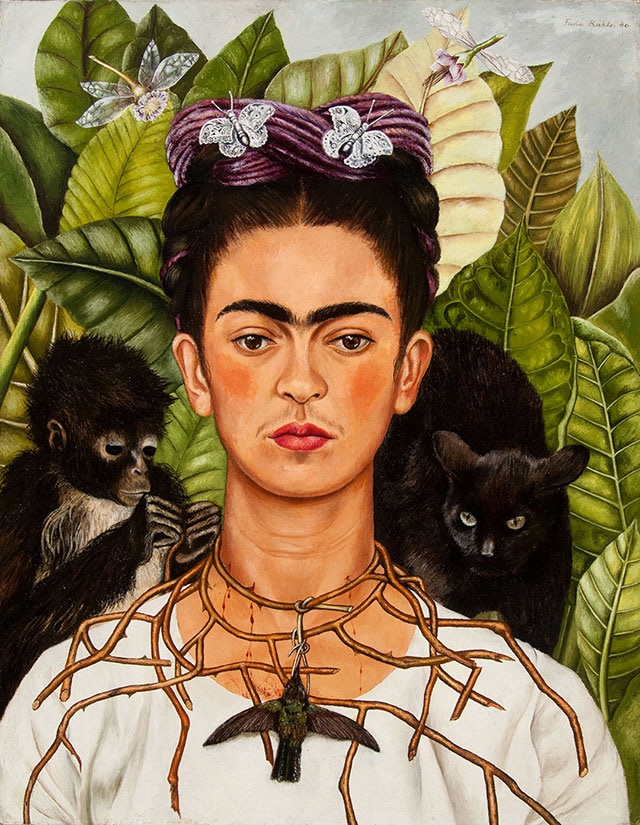
Frida Kahlo
 Mexico
Also known as: Magdalena Carmen Frida Kahlo y Calderón
Geburtstag
July 6, 1907
Sternzeichen
Cancer
Geburtsort
Coyoacán, Mexico City, Mexico
Alter
Gestorben mit 47
Größe
5 ft 3 in (160 cm)
Über
Frida Kahlo, born Magdalena Carmen Frida Kahlo y Calderón on July 6, 1907, in Coyoacán, Mexico City, was a Mexican painter whose work has become synonymous with bold self-expression and cultural pride. Known for her many self-portraits, she used a naïve folk art style to explore identity, postcolonialism, gender, class, and race. Her paintings mix realism with fantasy, often drawing from her own life, including her chronic pain. She is celebrated as an icon for Chicanos, feminists, and the LGBTQ+ community, her uncompromising depictions of the female experience making her a global symbol of resilience and cultural identity. Her image has been featured on Mexican banknotes, and her home, La Casa Azul, is now the Frida Kahlo Museum, one of the most visited museums in Mexico City. The 2002 biopic Frida, starring Salma Hayek, won two Academy Awards and introduced her to a new generation. In 2018, she was ranked #1 on Rolling Stone's list of "10 Best Visual Artists of All Time," and in 2020, she was named one of TIME's "100 Women of the Year" as a proxy for 1937. The intense global cult of personality around her is sometimes called "Fridamania." Fans often dress as her for Halloween or "Frida Fest" events, and her image is a staple of Day of the Dead celebrations. The official social media accounts post a mix of art history, political statements aligned with her Communist past, and inspirational quotes. As of 2026, her estate is estimated to be worth $60–$80 million, managed by the Frida Kahlo Museum and the Diego Rivera and Frida Kahlo Trust.
Frühes Leben & Hintergrund
Kahlo wuchs im Familienhaus La Casa Azul in Coyoacán auf. Im Alter von sechs Jahren führte Kinderlähmung dazu, dass ihr rechtes Bein dünner war als das linke, und sie humpelte für den Rest ihres Lebens. Ihr Vater, ein Fotograf, ermutigte sie, Fußball zu spielen und zu schwimmen, um das Bein zu stärken. Sie war eine kluge, rebellische Schülerin und eines von nur 35 Mädchen an der Nationalen Vorbereitungsschule in Mexiko-Stadt. Dort sah sie zum ersten Mal Diego Rivera, der auf dem Campus ein Wandbild malte. Ein entscheidender Moment kam am 17. September 1925, als der Bus, in dem sie saß, mit einer Straßenbahn zusammenstieß. Der Unfall durchbohrte ihr Becken, brach ihre Wirbelsäule, Schlüsselbein, Rippen, Becken und rechtes Bein. Während ihrer langen, schmerzhaften Genesung, bewegungsunfähig in einem Gipskorsett, begann sie zu malen. Ihre Mutter ließ eine spezielle Staffelei anfertigen, damit sie im Bett malen konnte, und einen Spiegel über ihr anbringen, damit sie Selbstporträts malen konnte. Dieser Busunfall änderte ihr Leben völlig und machte aus einer Medizinstudentin eine Künstlerin. Sie gab oft 1910 als ihr Geburtsjahr an, den Beginn der mexikanischen Revolution, um ihr Leben mit dem modernen Mexiko zu verbinden.
Karriereentwicklung
Kahlos Durchbruch kam 1938, als der Surrealist André Breton ihre erste Einzelausstellung in der Julien Levy Gallery in New York organisierte. Die Ausstellung verkaufte etwa die Hälfte der 25 Gemälde, ein kommerzieller Erfolg. 1939 reiste sie nach Paris zu einer Ausstellung in der Renou & Colle Gallery, wo der Louvre The Frame kaufte, was sie zur ersten mexikanischen Künstlerin des 20. Jahrhunderts machte, die vom Museum erworben wurde. In den 1940er Jahren lehrte sie an der Escuela Nacional de Pintura, Escultura y Grabado „La Esmeralda“ und war Gründungsmitglied des Seminario de Cultura Mexicana. 1953 fand ihre erste Einzelausstellung in Mexiko in der Galería Arte Contemporáneo statt. Sie nahm in einem Krankenwagen an der Eröffnung teil und wurde zu ihrem Bett getragen, das in der Galerie aufgestellt war. Sie malte bis zu ihrem Tod 1954 weiter. Posthum gewann ihr Werk enorm an Bedeutung. 2021 wurde ihr Gemälde Diego y yo für 34,9 Millionen US-Dollar verkauft, ein Rekord für einen lateinamerikanischen Künstler bei einer Auktion. 1954 erhielt sie den Premio Nacional de Pintura von der mexikanischen Regierung. Eine große Ausstellung, „Frida Kahlo: The Life of an Icon“, tourt weltweit und bietet immersive digitale Erlebnisse. 2024 kündigte das Frida-Kahlo-Museum eine neue Dauerausstellung an, die sich auf ihr politisches Engagement konzentriert.
Karriereverlauf
Öffentliches Bild & Stil
Kahlos charakteristischer Stil umfasst ihre Monobraue, Blumenkränze, farbenfrohe Tehuana-Kleider und einen direkten, unerschrockenen Blick in ihren Selbstporträts. Sie wird als tragische, aber widerstandsfähige feministische Ikone dargestellt, als Symbol für Schmerz, der in Kunst verwandelt wird, und als Figur des kulturellen Stolzes für Mexikaner und Chicanos. Sie erschien 1937 auf dem Cover der Vogue, fotografiert von Toni Frissell, was sie einem amerikanischen Mode-Publikum vorstellte. TIME zeigte 2002 eine Illustration von ihr auf dem Cover, und Vanity Fair hatte im selben Jahr eine Titelgeschichte zum Film Frida. Der offizielle Instagram-Account @museofridakahlo hat über 1,1 Millionen Follower, die Facebook-Seite über 500.000 Follower. Der Twitter/X-Account @FridaKahlo hat über 300.000 Follower. Fans werden oft „Frida-Follower“ oder „Frida-Fans“ genannt, und es gibt eine starke Subkultur von „Frida-inspirierten“ Hochzeiten. Der Nachlass bringt weiterhin neue lizenzierte Produktlinien heraus, darunter eine aktuelle Zusammenarbeit mit einem gehobenen Modehaus.
Ruhm & Fandom (iFAMOUS Rankings)
Frida Kahlo remains the 1st most famous person from Mexico, a position she holds with quiet authority. Her standing extends far beyond her borders, ranking as the 3rd most famous person in Latin America and securing the 4th spot globally for her country of origin at the 4th most famous person in Mexico. Within the global pantheon of creativity, she is recognized as the 3rd most famous person in Art & Design, while her overall cultural footprint places her at the 185th most famous person in the world. These placements, consistent across recent cycles within the iFANN Global Fame Rankings, reflect an enduring devotion that transcends generations. The scale of this attention tracks how her image permeates media coverage, search behaviors, and consumption signals worldwide, cementing her status not merely as a historical figure but as a living presence in contemporary culture.
There is no formal name for her fanbase, though the term "Fridas" has emerged in cultural discourse to describe women who emulate her style or identify with her legacy rather than a structured organization. Unlike modern celebrities whose followers drive campaigns or fund billboards, Kahlo's devotees express their admiration through the preservation of her mythos. This mythology rests on verified biographical events amplified into folklore, such as her survival of a near-fatal bus accident which transformed physical suffering into the pain and passion evident in her self-portraits. Her tumultuous marriage to Diego Rivera and her distinct visual persona, elaborate Tehuana clothing and floral hairstyles adopted to assert Mexican identity, have become symbols of resistance. Recent institutional reactions underscore this devotion; a major exhibition broke pre-sale ticket records at the Tate, while activists filed lawsuits to prevent her paintings from leaving Mexico, arguing they are too culturally vital to be exported. These events highlight a fierce protection of her legacy by a global audience that treats her life story as high drama and her art as a national treasure.
Interessante Fakten und Legenden
Born Magdalena Carmen Frida Kahlo y Calderón on July 6, 1907, in Coyoacán, she became a painter whose work defined bold self-expression and cultural pride. Known for her many self-portraits, she utilized a naïve folk art style to explore identity, postcolonialism, gender, class, and race. Her paintings mixed realism with fantasy, often drawing from her own life and chronic pain. She was celebrated as an icon for Chicanos, feminists, and the LGBTQ+ community, with her uncompromising depictions of the female experience making her a global symbol of resilience. Her image appeared on Mexican banknotes, and her home, La Casa Azul, served as a museum. Her signature style included her unibrow, flower crowns, colorful Tehuana dresses, and a direct gaze. She appeared on the cover of Vogue in 1937, photographed by Toni Frissell, introducing her to an American fashion audience. TIME featured an illustration of her on its cover in 2002, and Vanity Fair had a spread. She was bisexual and had affairs with both men and women, including the singer Chavela Vargas. She was an avid political activist and joined the Mexican Communist Party in 1928. She loved wearing traditional Tehuana dresses to highlight her Indigenous heritage and hide her scarred leg. She often incorporated her unibrow and facial hair into her self-portraits as a deliberate statement against conventional beauty standards. Her height was 5 feet 3 inches (160 cm). She was honored with a Google Doodle on July 6, 2010, for her 103rd birthday. Notable quotes include: "I paint self-portraits because I am so often alone, because I am the person I know best" (from her diary, circa 1940s); "They thought I was a Surrealist, but I wasn't. I never painted dreams. I painted my own reality" (interview, 1953); "Feet, what do I need you for when I have wings to fly?" (from her diary, 1953, after her leg amputation); and "I hope the exit is joyful, and I hope never to return" (final diary entry, 1954). A story fans still retell involves her near-fatal bus accident in 1925, which sparked her artistic career during recovery. Another legend centers on her relationship with Diego Rivera, marked by volatility and infidelities, including rumors of an affair with Leon Trotsky. Her deliberate rejection of beauty norms, growing a mustache and unibrow, became a core part of her lore.
Bemerkenswerte Zitate
“I paint self-portraits because I am so often alone, because I am the person I know best.”
“They thought I was a Surrealist, but I wasn't. I never painted dreams. I painted my own reality.”
“Feet, what do I need you for when I have wings to fly?”
“I hope the exit is joyful — and I hope never to return.”
Familie & Privatleben
Kahlos Vater, Guillermo Kahlo, war ein deutscher Einwanderer und Fotograf. Ihre Mutter, Matilde Calderón y González, war indigener und spanischer Abstammung. Sie hatte drei Schwestern: Matilde, Adriana und Cristina. Kahlo hatte nie Kinder; eine Schwangerschaft 1930 wurde aus medizinischen Gründen abgebrochen, und spätere Fehlgeburten machten sie zutiefst depressiv. Sie und Rivera lebten in La Casa Azul, das später zum Frida-Kahlo-Museum wurde. Das Haus war voller Tiere, darunter Affen, Papageien und ein Xoloitzcuintli-Hund. Sie besaß auch ein Haustierhirsch namens Granizo.
Bemerkenswerte Verbindungen
Diego Rivera, ihr Ehemann und Künstlerkollege, war ein lebenslanger Einfluss. André Breton, der surrealistische Schriftsteller, förderte ihr Werk und organisierte ihre erste große Ausstellung. Der Fotograf Nickolas Muray, ihr Liebhaber, hielt ikonische Bilder von ihr fest. Salma Hayek porträtierte sie in der 2002 erschienenen Filmbiografie und trug dazu bei, ihre Geschichte einem globalen Publikum näherzubringen.
Beziehungen & Dating-Vergangenheit
Kahlos erste ernsthafte Beziehung war mit Alejandro Gómez Arias, einem charismatischen Studentenführer an der National Preparatory School. Sie waren von 1922 bis 1927 zusammen, und er war während des Busunfalls 1925 bei ihr. Die Beziehung endete aufgrund der Missbilligung seiner Familie und seiner Untreue. 1929 heiratete sie Diego Rivera, einen notorischen Frauenhelden. Ihre Ehe war leidenschaftlich, aber turbulent, geprägt von Affären auf beiden Seiten. Kahlo hatte Affären mit Männern und Frauen, darunter der Fotograf Nickolas Muray (von 1931 bis 1941 immer wieder), der Bildhauer Isamu Noguchi (1936–1937), der deutsche Kunsthändler Heinz Berggruen (1938) und der katalanische Künstler José Bartolí (1946–1950). Eine vermeintliche Affäre mit dem exilierten russischen Revolutionär Leo Trotzki im Jahr 1937 führte zu einem Zerwürfnis zwischen Kahlo und Rivera. Sie ließen sich 1939 scheiden, heirateten aber ein Jahr später am 8. Dezember 1940 erneut und führten eine platonische Lebensgemeinschaft bis zu ihrem Tod. Stand 2026 ist Frida Kahlo verstorben.
- DatiertAlejandro Gómez Arias1922 - 1927Ihr erster ernsthafter Freund; sie waren während des Busunfalls zusammen.
- VerheiratetDiego Rivera1929 - 1939Erste Ehe, turbulent mit Untreue.
- DatiertNickolas Muray1931 - 1941Immer wiederkehrende Affäre; Muray machte ikonische Fotografien von Kahlo.
- DatiertIsamu Noguchi1936 - 1937Affäre, während Rivera mit ihrer Schwester Cristina zusammen war.
- GerüchteweiseLeon Trotsky1937 - 1939Weithin angenommene Affäre, während Trotzki im Blauen Haus lebte.
- DatiertHeinz Berggruen1938 - 1938Kurze Beziehung mit dem deutschen Kunsthändler.
- VerheiratetDiego Rivera1940 - 1954Zweite Ehe, platonische Gefährtschaft bis zu ihrem Tod.
- DatiertJosé Bartolí1946 - 1950Fernbeziehung mit dem katalanischen Künstler.
Tod und Nachwirkungen
Gestorben
July 13, 1954 (im Alter von 47 Jahren)
Sterbeort
Coyoacán, Mexico City, Mexico
Todesursache
Pulmonary embolism
The announcement of Frida Kahlo's passing came from her family at La Casa Azul in Coyoacán, confirming the end of a life marked by intense physical struggle and artistic brilliance. On July 13, 1954, she died at the age of 47 within the very home where she had spent so much of her creative life, bedridden and isolated by the severe complications of gangrene that had necessitated the amputation of her right leg earlier that year. Her final diary entry reading "I hope the exit is joyful, and I hope never to return" was widely interpreted by historians as relief from chronic suffering rather than an act of suicide, effectively refuting rumors that had circulated about her intent. Public reaction at the time remained subdued, confined largely to close peers and the Mexican art community since she had not yet achieved global fame.
Her husband, Diego Rivera, was devastated by the loss and fell into a deep depression, dying just over a year later in 1957. The funeral was a private affair attended by Rivera, their daughter Matilde Kahlo, and friends like photographer Lola Álvarez Bravo before she was cremated at the Panteón Civil de Dolores. Her ashes were eventually interred at La Casa Azul, which Rivera converted into a museum dedicated to her memory. In the decades that followed, her legacy surged through feminist art history and the publication of her diaries, leading to major exhibitions, the 2002 film Frida, and enduring recognition as a global icon of resilience.
Vermögen (Nachlasswert)
$80 Million
Schätzung der iFANN-Redaktion
As Frida Kahlo is deceased, her net worth refers to the value of her estate, which is estimated at $80 Million per iFANN's editorial analysis as of 2026. The estate generates income through licensing her image, which is one of the most licensed in the world, appearing on everything from T-shirts to sneakers to Barbie dolls. Merchandise sales, royalties from book and art print sales, and admissions to the Frida Kahlo Museum in Mexico City also contribute. The estate is managed by the Frida Kahlo Museum and the Diego Rivera and Frida Kahlo Trust, which aggressively protects her intellectual property. The trust has sued companies for unauthorized use of her likeness, maintaining the estate's value. Some fan sites project an estate value as high as $200 million, but this is considered a forward-looking projection based on potential future licensing deals.
Gewonnene Auszeichnungen (1)
Kahlo erhielt 1954, kurz vor ihrem Tod, den Premio Nacional de Pintura von der mexikanischen Regierung. Ihr Werk wurde posthum durch Museumsausstellungen und kulturelle Anerkennung geehrt, unter anderem durch die Abbildung auf mexikanischen Banknoten und in Google Doodles.
1954 · Nationaler Preis für Malerei
Lifetime achievement
Bekannt für
Self-Portrait with Thorn Necklace and Hummingbird
1940 · Maler
The Two Fridas
1939 · Maler
The Broken Column
1944 · Maler
Diego y yo
1949 · Maler
The Frame
1938 · Maler
Schlagwörter
Kurzfakten
- Beruf
- painter, artist
- Geboren
- July 6, 1907
- Geburtsort
- Coyoacán, Mexico City, Mexico
- Gestorben
- July 13, 1954
- Sterbeort
- Coyoacán, Mexico City, Mexico
- Geschlecht
- Weiblich
- Ehepartner
- Diego Rivera
- Sternzeichen
- Cancer
Persönliche Details
- Vollständiger Name
- Magdalena Carmen Frida Kahlo y Calderón
- Größe
- 5 ft 3 in (160 cm)
- Ehepartner
- Diego Rivera
- Bildung
- National Preparatory School, Mexico City
Häufig gestellte Fragen
Wofür ist Frida Kahlo am bekanntesten?
Wie starb Frida Kahlo?
Hatte Frida Kahlo Kinder?
Warum malte Frida Kahlo so viele Selbstporträts?
War Frida Kahlo eine Surrealistin?
Ähnliche Personen
Der Community beitreten
Fans diskutieren