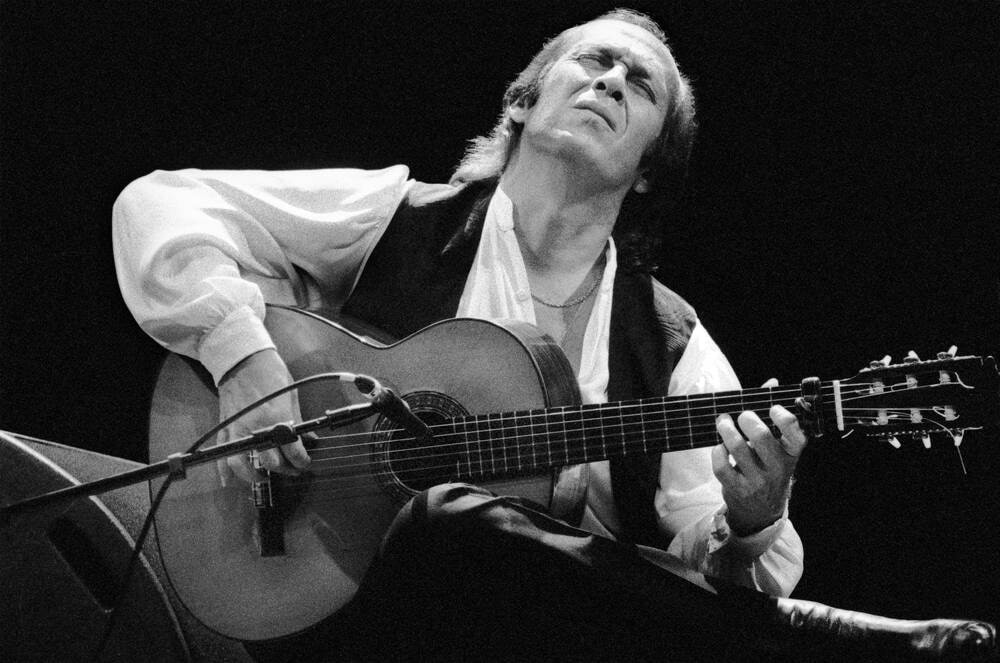
Paco de Lucía
 Spain
Spainguitarist•composer•jazz musician
Geburtstag
December 21, 1947
Sternzeichen
Sagittarius
Geburtsort
Algeciras, Spain
Alter
Gestorben mit 66
Größe
5 ft 7 in (170 cm)
Über
Paco de Lucía, geboren als Francisco Gustavo Sánchez Gómez, war ein spanischer Flamenco-Gitarrist, Komponist und Plattenproduzent, der das Genre transformierte. Er führte den Flamenco in klassische und Jazz-Gefilde und erhielt Lob von Eric Clapton als „titanische Figur in der Welt der Flamenco-Gitarre“. Seine blitzschnellen Picados und der innovative Einsatz abstrakter Akkorde und Jazz-Tonleitern zeichneten ihn aus. Die Zusammenarbeit mit dem Sänger Camarón de la Isla in den 1970er Jahren brachte zehn wegweisende Alben hervor. Titel wie „Entre dos aguas“ und „Río Ancho“ wurden zu Klassikern, wobei letzterer berühmt mit Al Di Meolas „Mediterranean Sundance“ fusioniert wurde. Er arbeitete auch mit John McLaughlin und Chick Corea zusammen und erweiterte so seine globale Reichweite. 1981 gründete er mit seinen Brüdern das Paco de Lucía Sextet. Nach 2004 reduzierte er seine Tourneen und spielte nur noch ausgewählte Konzerte. De Lucía verstarb am 25. Februar 2014 im Alter von 66 Jahren und hinterließ ein Vermächtnis als einer der größten Gitarristen der Geschichte.
Frühes Leben & Hintergrund
Paco de Lucía wuchs in einem armen Flamenco-Haushalt in Algeciras als jüngstes von fünf Kindern auf. Sein Vater, Antonio Sánchez, war Flamenco-Gitarrist, und seine Mutter, Lucía Gómez, war Sängerin. Er begann im Alter von fünf Jahren Gitarre zu spielen, unterrichtet von seinem Vater, der ihn zwang, rechtshändig zu spielen, obwohl er von Natur aus Linkshänder war. Mit 11 verließ er die Schule, um sich ganz der Musik zu widmen. Mit 14 gewann er einen Flamenco-Wettbewerb in Jerez de la Frontera, sein erster entscheidender Moment. 1964, mit 16, schloss er sich der Flamenco-Truppe des Tänzers José Greco an und tourte durch Europa und Amerika. Ein wichtiger früher Schritt war die Begegnung mit dem Sänger Camarón de la Isla im Jahr 1968, die eine legendäre Zusammenarbeit begann, die den modernen Flamenco prägen sollte.
Karriereentwicklung
De Lucías Durchbruch kam 1975 mit dem Album Fuente y caudal, das „Entre dos aguas“ enthielt, eine Rumba-Flamenco-Fusion, die über eine Million Mal verkauft wurde und sein Markenzeichen wurde. Seine Zusammenarbeit mit Camarón de la Isla brachte zehn Alben hervor, darunter La leyenda del tiempo (1979), eine bahnbrechende Fusion von Flamenco mit Rock und Jazz. 1980 schloss er sich John McLaughlin und Al Di Meola für Friday Night in San Francisco an, das über zwei Millionen Mal verkauft wurde und zu einem wegweisenden Akustikgitarren-Album wurde. Der Titel „Mediterranean Sundance“ ist ikonisch. 1981 gründete er mit seinen Brüdern das Paco de Lucía Sextet, das Flamenco mit Latin-Jazz verband. In den 1990er Jahren erforschte er klassische Werke wie Joaquín Rodrigos Concierto de Aranjuez (1991). Er gewann 2004 einen Latin Grammy für Cositas buenas. 2010 erhielt er den Prinz-von-Asturien-Preis für die Künste.
Karriereverlauf
Öffentliches Bild & Stil
De Lucía war bekannt für seine intensiven, improvisierten Live-Auftritte und seine schlichte, dunkle Bühnenkleidung. Die Medien porträtierten ihn als schüchternes, privates Genie, das den Flamenco revolutionierte. Seine Musik verband traditionellen Flamenco mit Jazz, Klassik und Weltmusik. Fans, oft Flamenco-Enthusiasten genannt, versammeln sich jährlich in Algeciras zu Tribut-Konzerten an seinem Geburts- und Todestag. Die Facebook-Seite des Nachlasses veröffentlicht Archivmaterial in respektvollem Ton.
Ruhm & Fandom (iFAMOUS Rankings)
Paco de Lucía holds the position of the 83rd most famous person in Classical, a standing down from 82nd last cycle, within the iFANN Global Fame Rankings. His legacy as a transformative figure remains deeply embedded in the cultural consciousness long after his passing. While the world reveres him as a virtuoso who bridged flamenco with jazz and classical traditions, his fanbase does not operate under a formal collective name. Unlike modern pop icons who cultivate branded movements, the community surrounding Paco de Lucía is defined by scattered devotion rather than organized campaigns. Enthusiasts gather annually in Algeciras for tribute concerts on his birthday and death anniversary, honoring a man who preferred the shadows to the spotlight. The absence of a specific fandom title reflects his status as a serious artist whose work invites study and performance rather than idolization. Even stories of his private life, such as the account of him living next door to Paul McCartney but fearing to introduce himself, circulate among those who cherish his humility. This quiet reverence ensures that his music continues to be performed by new generations, keeping the spirit of his innovation alive without the noise of celebrity culture.
Interessante Fakten und Legenden
De Lucía was a heavy smoker and suffered from a heart condition, factors that contributed to his sudden death at age 66. He never learned to read music notation, relying entirely on his ear to craft complex compositions. In a surprising turn of events, he declined an offer to join the Rolling Stones as a guitarist during the 1970s. His son Francisco carries on the family tradition as a flamenco guitarist who performs tribute shows. The nickname "de Lucía" originated from his mother to distinguish him from other guitarists named Paco. A close friendship with Eric Clapton saw the rock legend call him "a titanic figure." The defining moment of his final days involves a story fans still retell: he died on February 25, 2014, while playing guitar with his children on a beach in Cancún. Though this event is a verified historical fact, it has taken on a legendary quality regarding his devotion to family even in leisure. Another iconic chapter of his career is the "Saturday Night in San Francisco" concert from December 6, 1980. This collaboration with Al Di Meola and John McLaughlin is frequently cited as the pinnacle of flamenco-jazz fusion, cementing the album *Friday Night in San Francisco* as one of the best-selling instrumental records ever.
Bemerkenswerte Zitate
“Flamenco is not just music; it's a way of life.”
“I never wanted to be a virtuoso. I just wanted to play from the heart.”
“The guitar is my voice. When I play, I say what I cannot say with words.”
“Camarón was my brother. Without him, I would not be who I am.”
“Music is a constant search. You never arrive; you just keep walking.”
Familie & Privatleben
De Lucía heiratete Casilda Varela im Jahr 1977. Sie hatten drei Kinder: Lucía (geboren 1979), Francisco (geboren 1981) und Antonia (geboren 1986). Casilda verwaltete seine Geschäfte und später seinen Nachlass. Seine Brüder Pepe (Sänger und Tänzer) und Ramón de Algeciras (Gitarrist) waren häufige Mitarbeiter im Paco de Lucía Sextet. Sein Vater, Antonio Sánchez, war sein erster Gitarrenlehrer. Die Familie lebte viele Jahre in Madrid.
Bemerkenswerte Verbindungen
De Lucías bekanntester musikalischer Partner war Camarón de la Isla, mit dem er zwischen 1968 und 1979 zehn Alben aufnahm. Er arbeitete auch intensiv mit den Jazzgitarristen John McLaughlin und Al Di Meola zusammen, vor allem auf Friday Night in San Francisco (1980). Weitere Mitarbeiter sind Chick Corea, Larry Coryell und Tommy Emmanuel. Seine Brüder Pepe und Ramón waren Teil seines Sextetts.
Beziehungen & Dating-Vergangenheit
De Lucías einzige öffentliche Beziehung war mit Casilda Varela. Sie lernten sich Anfang der 1970er Jahre in Madrid kennen, als sie Studentin war. Sie heirateten 1977 und bekamen drei Kinder: Lucía, Francisco und Antonia. Casilda verwaltete seine Geschäfte. Sie blieben bis zu seinem Tod 2014 verheiratet. Es sind keine anderen Beziehungen oder öffentlichkeitswirksamen Affären dokumentiert.
- VerheiratetCasilda Varela1977 - 2014Sie lernten sich Anfang der 1970er Jahre in Madrid kennen und heirateten 1977. Sie verwaltete seine Geschäfte und später seinen Nachlass. Sie hatten drei gemeinsame Kinder.
Tod und Nachwirkungen
Gestorben
February 25, 2014 (im Alter von 66 Jahren)
Sterbeort
Mazatlán, Sinaloa, Mexico
Todesursache
Cardiac arrest (acute myocardial infarction)
The music world reacted with immediate, global mourning when the news broke of Paco de Lucía's passing. Tributes poured in from peers like Al Di Meola, John McLaughlin, and Chick Corea, who described him as a revolutionary figure bridging jazz and flamenco. Institutions such as the Royal Conservatory of Music in Madrid and the Flamenco Festival of Jerez issued formal condolences, while fans gathered spontaneously outside his childhood home in Algeciras and at the Plaza de la Constitución in Cádiz. The guitarist died on February 25, 2014, at his home in Mazatlán, Sinaloa, Mexico, shortly after finishing a concert at the Mazatlán Cultural Center earlier that evening.
According to official statements released by his family and confirmed by Mexican authorities, the cause was cardiac arrest, specifically an acute myocardial infarction. He suffered the heart attack while relaxing at his residence later that night and passed away before medical personnel could arrive. The family declined an autopsy, citing the clear nature of the sudden cardiac event and the desire for privacy. A private funeral ceremony took place on February 27, 2014, in Algeciras, Spain, followed by his burial in the Cementerio de San Juan Bautista. The service was attended by close family members, friends, and fellow musicians, though details regarding specific attendees remained confidential.
Posthumous releases have continued to celebrate his legacy, including the 2023 archival set Paco de Lucía: The Montreux Years (Live) and various reissues of live recordings. Notable tributes include the "Paco de Lucía Legacy Festival" in New York City in February 2024 and Sara Baras's four-act production titled Vuela at the Flamenco Festival Miami.
Vermögen (Nachlasswert)
$12 Million
Schätzung der iFANN-Redaktion
Per iFANN's editorial analysis, the estate of Paco de Lucía is valued at $12 Million as of 2026. The estate is managed by his widow Casilda Varela and his children. Revenue streams include royalties from his extensive catalog, particularly Fuente y caudal and Friday Night in San Francisco, which generate an estimated $500,000 annually. Posthumous releases like the compilation Canción de amor (2014) and the documentary soundtrack Paco de Lucía: La búsqueda (2017) add income. Licensing deals for film and TV, plus sales of guitar instructional materials and signature model guitars, also contribute. The Paco de Lucía Foundation, established in 2015, promotes flamenco education but is not a major revenue source.
Gewonnene Auszeichnungen (5)
De Lucía gewann 2004 einen Latin Grammy für Cositas buenas. Er erhielt 2010 Spaniens Prinz-von-Asturien-Preis für die Künste und posthum 2014 einen Grammy Lifetime Achievement Award. Außerdem erhielt er die Goldmedaille für Verdienste um die Schönen Künste (2007) und einen Ehrendoktortitel des Berklee College of Music (2012).
2004 · Bestes Flamenco-Album
Cositas buenas
2014 · Lebenswerk
Bekannt für
Fuente y caudal
1975 · Composer, Guitarist
Friday Night in San Francisco
1980 · Gitarrist
Collaboration with Camarón de la Isla
1968-1979 · Guitarist, Composer
Paco de Lucía Sextet
1981 · Founder, Guitarist
Concierto de Aranjuez
1991 · Gitarrist
Schlagwörter
Kurzfakten
- Beruf
- guitarist, composer, jazz musician
- Geboren
- +1947-12-21
- Geburtsort
- Algeciras
- Gestorben
- +2014-02-25
- Sterbeort
- Playa del Carmen
- Geschlecht
- Männlich
- Sternzeichen
- Sagittarius
Persönliche Details
- Vollständiger Name
- Francisco Gustavo Sánchez Gómez
- Größe
- 5 ft 7 in (170 cm)
- Ehepartner
- Casilda Varela
- Kinder
- Lucía (b. 1979), Francisco (b. 1981), Antonia (b. 1986)
Häufig gestellte Fragen
Wie ist Paco de Lucía gestorben?
Wer war Paco de Lucías Ehefrau?
Was ist Paco de Lucías berühmtestes Lied?
Hatte Paco de Lucía Kinder?
War Paco de Lucía Linkshänder?
Soziale Medien
Ähnliche Personen
Der Community beitreten
Fans diskutieren