 Italy
Über
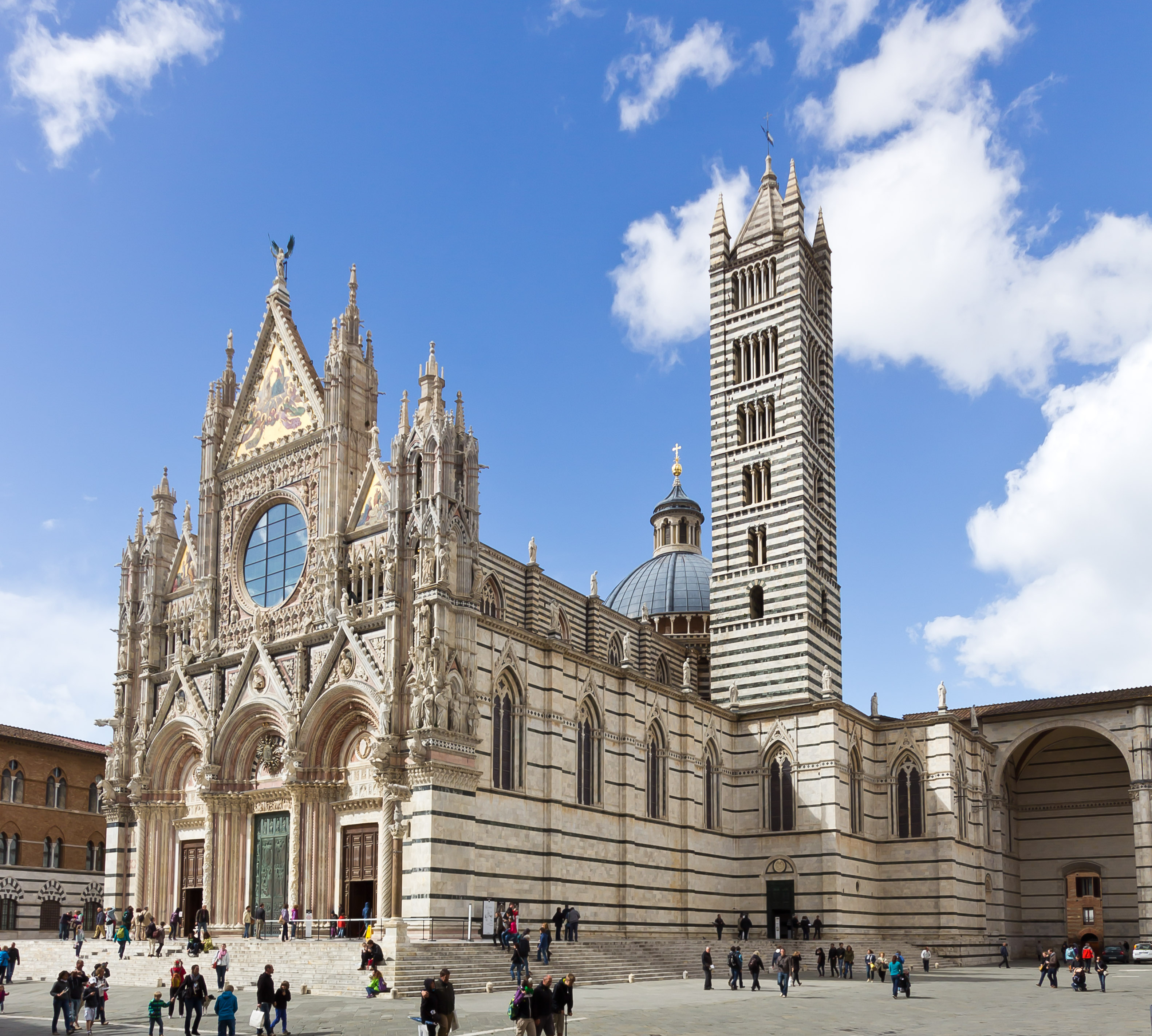
Siena Cathedral, known locally as the Duomo di Siena or Cattedrale di Santa Maria Assunta, stands as a towering symbol of medieval civic pride and religious devotion. Located in the Piazza del Duomo, this Roman Catholic church is not merely a place of worship but a living museum where centuries of artistic evolution converge. The building's exterior immediately commands attention with its bold black-and-white striped marble facade, a design choice that reflects the city's unique coat of arms and sets it apart from the more uniform stone structures of neighboring Florence.
Inside, the cathedral reveals a stunning synthesis of Romanesque solidity and Gothic verticality. The nave stretches toward an altar dedicated to the Assumption of Mary, flanked by columns that guide the eye upward. While the structure itself is magnificent, the true marvel lies beneath the feet of visitors. The marble mosaic floor, a complex tapestry of biblical scenes, pagan mythology, and allegorical figures, covers nearly the entire nave and transept. This intricate artwork was not created in a single burst but evolved over six centuries, with artists adding new panels while others were covered or restored.
The institution operates today under the stewardship of the Opera della Metropolitana di Siena, a non-profit foundation tasked with preserving this fragile heritage. Unlike many historic sites that function solely as museums, the cathedral remains an active parish church where daily masses are celebrated alongside guided tours. This dual role creates a dynamic atmosphere where the sacred rituals of the faithful coexist with the awe of international tourists exploring one of Italy's most significant cultural landmarks.
Mission
The primary mission of Siena Cathedral is to serve as a center for Catholic liturgy while simultaneously safeguarding an unparalleled collection of medieval and Renaissance art. The managing body, Opera Duomo, dedicates its resources to the conservation of the building's structural integrity and its delicate artworks. A core part of this mandate involves the preservation of the famous marble mosaic floor, which requires meticulous cleaning and restoration cycles to prevent damage from foot traffic and environmental factors.
Beyond conservation, the organization actively promotes cultural education through temporary exhibitions and public programs. Recent initiatives include hosting photography shows like SIBYLS within the crypt and uncovering specific sections of the floor for special viewing periods. These efforts ensure that the cathedral remains a vibrant space for contemporary dialogue about art and history rather than a static relic of the past.
Geschichte
Construction on the cathedral began in the early 13th century following a consecration recorded in 1179, though the traditional founding date is set at 1196. The project quickly grew into a massive undertaking that defined the skyline of Siena. By 1263, the dome had been completed, rising 48 meters above the city. The architects blended Romanesque heaviness with emerging Gothic lightness, creating a distinctive aesthetic that relied heavily on white and green marble strips.
A pivotal moment in the building's timeline occurred in the early 14th century when the city launched the Duomo Nuovo project. This ambitious plan aimed to extend the nave and construct a new baptistery to create the largest church in Christendom. Construction crews began work on the northern walls, but the Black Death of 1348 devastated the population and halted the project permanently. Those unfinished walls remain standing today, a silent monument to the city's lost grandeur.
Over the next few centuries, the cathedral became a repository for the finest artistic talent of the era. The marble mosaic floor saw continuous work from the 14th through the 16th centuries, with masters like Pinturicchio and Domenico Beccafumi contributing designs that blended theological narratives with classical imagery. In the early 1500s, the Piccolomini Library was added to honor Pope Pius II, filling the apse with colorful frescoes. Despite earthquakes and wars, the structure has endured as the spiritual anchor of the city.
Unterabteilungen
Piccolomini Library
A library housing illuminated manuscripts and frescoes by Pinturicchio depicting the life of Pope Pius II.
Siena Cathedral Pulpit
An octagonal masterpiece carved by Nicola Pisano featuring relief sculptures of Old Testament scenes.
Campanile
The bell tower offering panoramic views of the Tuscan countryside and the city below.
Crypt
An underground space housing the cathedral treasury and serving as a venue for modern art exhibitions.
Museo dell'Opera del Duomo
A museum complex displaying original artworks removed from the cathedral and featuring the Facciatone viewpoint.
Bemerkenswerte Personen
Nicola Pisano
Bildhauer · 1265-1268
Carved the cathedral's pulpit, establishing a new standard for medieval Italian sculpture.
Pinturicchio
Maler · 1502-1507
Frescoed the Piccolomini Library with vivid scenes from the life of Pope Pius II.
Donatello
Bildhauer · 1450s
Created the bronze statue of John the Baptist, now housed in the cathedral museum.
Michelangelo
Bildhauer · 1501-1504
Sculpted the Piccolomini Altar figures, including a young Saint Peter.
Meilensteine
1179
Cathedral consecrated.
1196
Traditional founding date established.
1263
Dome completed, reaching a height of 48 meters.
1348
Black Death halts the major expansion project known as the Duomo Nuovo.
1502-1507
Pinturicchio completes the frescoes in the Piccolomini Library.
2026
The cathedral unveils the marble mosaic floor again for the Jubilee of Saint Francis.
Quellen
Organisationsinfo
- Gegründet
- 1196
- Hauptsitz
- Piazza del Duomo, Siena, Tuscany, Italy
- Land
- Italy
- Übergeordnet
- Opera della Metropolitana di Siena
- Typ
- Religious
- Typ
- Religious
- Gegründet
- +1196
- Land
- Italy
- Dedication
- Assumption of Mary
- Architectural Style
- Romanesque-Gothic
- Dome Height
- 48 meters
Offizielle Webseite
www.operaduomo.siena.it
Der Community beitreten
Fans diskutieren