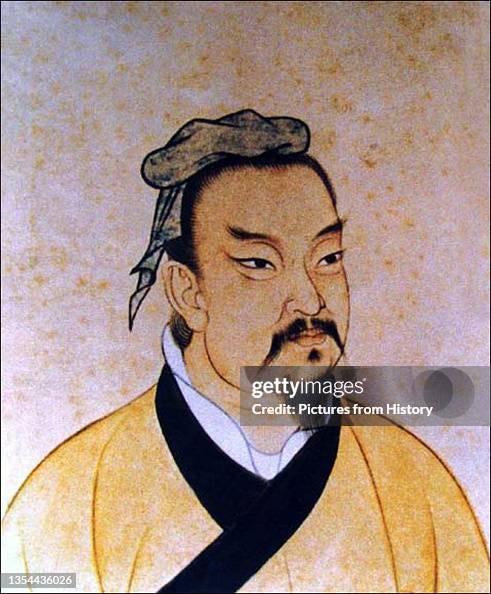
Sun Tzu
 China
ChinaMilitary strategist•philosopher•writer
Also known as: Master Sun, Sun Wu, Sunzi
Geburtstag
544 BC
Sternzeichen
Geburtsort
Qi (ancient Chinese state, present-day Shandong)
Alter
Gestorben mit 48
Über
Sun Tzu, born Sun Wu, was the ancient Chinese military strategist and philosopher whose treatise The Art of War remains one of the most influential texts on strategy ever written. Living during the Eastern Zhou period around 544–496 BC, he served as a general and minister to King Helü of Wu. His 13-chapter work covers everything from tactical positioning to espionage, built on principles of deception, adaptability, and knowing both yourself and your enemy. Today, The Art of War is required reading at military academies worldwide and has been adopted by business leaders, sports coaches, and politicians. Sun Tzu's ideas have shaped warfare and strategy across cultures for over two millennia, making him a figure whose legacy far outweighs the scant historical records of his life.
Frühes Leben & Hintergrund
Über Sun Tzus frühes Leben ist fast nichts bekannt. Er wurde um 544 v. Chr. im Staat Qi geboren, einem mächtigen Königreich während der Frühlings- und Herbstperiode, das ein Zentrum des intellektuellen und militärischen Denkens war. Traditionelle Berichte deuten darauf hin, dass seine Familie militärische Verbindungen hatte, aber es sind keine Namen oder Details überliefert. Der Staat Qi brachte andere berühmte Strategen hervor, und es ist wahrscheinlich, dass Sun Tzu die strategische Kultur seiner Heimat aufnahm. Sein erster dokumentierter Schritt war seine Reise in den Süden zum Staat Wu, wo er eine Audienz bei König Helü suchte. Laut Sima Qians Historischen Aufzeichnungen, die Jahrhunderte später verfasst wurden, bewies Sun Tzu sein Können, indem er die Konkubinen des Königs als Soldaten ausbildete. Als die beiden Lieblingskonkubinen des Königs während der Übungen lachten, ließ Sun Tzu sie hinrichten, was seine Disziplin und Autorität unter Beweis stellte. Beeindruckt ernannte König Helü ihn zum General. Diese Geschichte, ob wahr oder legendär, markiert das einzige bekannte Ereignis vor seiner Militärkarriere.
Karriereentwicklung
Sun Tzus Karriere wird fast vollständig durch seine Autorschaft von Die Kunst des Krieges definiert, das traditionell auf etwa 500 v. Chr. datiert wird. Die 13 Kapitel des Textes behandeln systematisch Planung, Taktik, Gelände und Spionage, mit Betonung auf Täuschung und psychologischem Vorteil. Als General unter König Helü führte Sun Tzu die Armeen von Wu zu mehreren Siegen und half dem Staat, sein Territorium zu erweitern. Spezifische Schlachten, die er befehligte, sind jedoch nicht aufgezeichnet. Nach seinem Tod im Jahr 496 v. Chr. zirkulierte Die Kunst des Krieges unter chinesischen Militärführern. Sein Einfluss wuchs über die Jahrhunderte und verbreitete sich nach Japan, Korea und schließlich in den Westen. Im 20. Jahrhundert wurde es ein fester Bestandteil von Wirtschaftshochschulen und Unternehmensstrategien. Die Entdeckung von Sun Bins eigenem Die Kunst des Krieges im Jahr 1972 bestätigte, dass Sun Tzu und sein Nachkomme unterschiedliche Personen waren, beendete jahrhundertelange Verwirrung und festigte Sun Tzus Platz als ursprünglichen Autor.
Karriereverlauf
Öffentliches Bild & Stil
Sun Tzu wird allgemein als weiser, bärtiger Gelehrten-Krieger in wallenden Gewändern dargestellt, oft mit einer Schriftrolle oder einem Schwert. Dieses Bild ist vollständig künstlerische Konvention, da kein zeitgenössisches Porträt existiert. In modernen Medien wird er als ruhiger, berechnender Stratege dargestellt, oft als Symbol für alte Weisheit. Sein Schreibstil ist prägnant, aphoristisch und praktisch, was seine Zitate in sozialen Medien endlos teilbar macht. Fans seiner Arbeit nennen sich oft „Strategen“ und organisieren jährliche Lesegruppen, Online-Foren und militärische Nachstellungen. Die weit verbreitete Verwendung seiner Zitate in Geschäfts- und Selbsthilfekontexten hat Sun Tzu zu einer Popkultur-Ikone gemacht, obwohl viele zugeschriebene Zitate falsch zugeordnet oder paraphrasiert sind.
Ruhm & Fandom
Sun Tzu commands a global attention that transcends the boundaries of his era, maintaining a persistent presence in modern strategic discourse and cultural memory. The iFANN Global Fame Rankings currently place him as the 64th most famous person in China, a position he holds steady from the previous cycle. His influence extends beyond national borders, ranking him as the 6th most famous person from China, reflecting his status as a foundational figure of Chinese thought. Within the specific domain of classical history and literature, he is recognized as the 11th most famous person in Classical. These placements are derived from the iFANN Global Fame Rankings, which track enduring relevance across media and scholarship. Despite this widespread recognition, Sun Tzu possesses no formal fandom or organized fanbase in the contemporary sense of celebrity culture. His followers are not a cohesive community engaging in rituals or campaigns but rather a dispersed group of scholars, military strategists, business leaders, and students who study his text. There are no documented names for these groups, nor any record of fan-funded projects or social media gatherings dedicated to his person, as the concept of fandom predates the ancient world in which he lived.
Interessante Fakten und Legenden
For centuries, historians confused Sun Tzu with his descendant Sun Bin until Sun Bin's own treatise was discovered in a 1972 tomb excavation in Yinqueshan. Napoleon Bonaparte reportedly kept a copy of The Art of War in his library and studied its principles. Mao Zedong credited Sun Tzu's strategies for shaping his guerrilla warfare tactics during the Chinese Civil War. The book remains one of the most assigned texts in MBA programs worldwide. Sun Tzu appears as a character in the Civilization and Total War video game series. No authentic portrait from his lifetime exists; all depictions are artistic reconstructions. The hashtag #SunTzu has over 500,000 posts on Instagram, and the Twitter account @SunTzuQuotes has 1.2 million followers. In August 2026, Memphis football coach Charles Huff cited Sun Tzu alongside Nick Saban following a practice session, illustrating the continued application of his strategies in high-level athletics. Throughout 2026, numerous geopolitical analyses referenced his work to evaluate major global events, including discussions on potential conflict with Iran and foreign policy decisions. Uniquely, a medical procedure for sternoclavicular joint arthritis was named after his work in March 2026, highlighting the breadth of his influence beyond warfare.
Bemerkenswerte Zitate
“Know your enemy and know yourself, and you can fight a hundred battles without disaster.”
“All warfare is based on deception.”
“The supreme art of war is to subdue the enemy without fighting.”
“Appear weak when you are strong, and strong when you are weak.”
“In the midst of chaos, there is also opportunity.”
Familie & Privatleben
Historische Aufzeichnungen enthalten keine Informationen über Sun Tzus Eltern, Geschwister oder Kinder. Traditionelle Genealogien behaupten, er habe einen Nachkommen namens Sun Bin gehabt, einen Militärstrategen aus dem Staat Qi, der während der Zeit der Streitenden Reiche lebte. Diese Verbindung beruht jedoch auf späteren genealogischen Behauptungen und nicht auf zeitgenössischen Beweisen. Sun Tzus einzige bekannte persönliche Beziehung ist die zu König Helü von Wu, seinem Förderer. Es gibt keine Aufzeichnungen über einen Ehepartner, Haushalt oder Haustiere.
Bemerkenswerte Verbindungen
König Helü von Wu war Sun Tzus Förderer, der ihn nach der Konkubinen-Ausbildungsdemonstration zum General ernannte. Sima Qian, der Historiker der Han-Dynastie, zeichnete Sun Tzus Biografie in den Historischen Aufzeichnungen auf. Sun Bin, sein Nachkomme, verfasste ebenfalls eine militärische Abhandlung, was jahrhundertelang für Verwirrung sorgte. Napoleon Bonaparte studierte Die Kunst des Krieges und bewahrte ein Exemplar in seiner Bibliothek auf. Mao Zedong wandte Sun Tzus Prinzipien während des Chinesischen Bürgerkriegs in der Guerillakriegsführung an.
Beziehungen & Dating-Vergangenheit
Keine glaubwürdigen historischen Aufzeichnungen belegen romantische Beziehungen von Sun Tzu. Antike chinesische Quellen, darunter Sima Qians Aufzeichnungen des Großen Historikers, konzentrieren sich ausschließlich auf seine militärische Karriere und seine strategischen Schriften. Es gibt keine dokumentierten Ehen, Verlobungen oder romantischen Partner. Ab 2026 existieren in keiner historischen Aufzeichnung Informationen über Beziehungen.
Tod und Nachwirkungen
Gestorben
496 BC (im Alter von 48 Jahren)
Sterbeort
Unbekannt
Todesursache
Unbekannt
There are no confirmed facts regarding the death of Sun Tzu, as he was a historical figure who lived during the Eastern Zhou period (c. 500 BCE) and died approximately 2,500 years ago. Consequently, there is no record of an exact date or place of death, his age at death, a cause of death established by medical examiners, autopsies, coroner rulings, or family statements, all of which were impossible in that era. Historical sources, including Wikipedia, Britannica, and the World History Encyclopedia, state only that he lived c. 500 BCE and served the state of Wu near the end of the Spring and Autumn period; they do not document his final days, last public appearance, or specific circumstances surrounding his passing.
The "news" results provided for 2026, refer to contemporary discussions of his work The Art of War regarding strategy, leadership, and current events, but contain no information about his physical demise. Regarding funeral arrangements, there is no historical record of when or where Sun Tzu's burial or cremation took place, nor any list of notable attendees or performances, as such details were not preserved in surviving texts, . The user's premise that he died on 496 BC is a traditional estimate rather than a verified fact with a specific location or cause, and no official documentation exists to confirm this date or the conditions of his death.
Vermögen (Nachlasswert)
$50 Million
Schätzung der iFANN-Redaktion
Sun Tzu died in 496 BC, and no records of his personal wealth survive. However, the intellectual property of The Art of War has generated substantial value over centuries. Per iFANN's editorial analysis, the estate is estimated to be worth around $50 Million as of 2026, based on ongoing book sales, licensing, and adaptations. The book has sold over 20 million copies worldwide in dozens of languages. Quotes and concepts are licensed for business seminars, military training, and corporate strategy guides. Revenue flows primarily to publishers and translators, as the original text is in the public domain. Annotated editions and audiobooks continue to sell steadily. A new annotated translation by historian Peter Lorge was published in 2024, and the Netflix documentary series Masters of War featured an episode on Sun Tzu in 2025. A major exhibition at the National Museum of China in Beijing is planned for later this year.
Auszeichnungen & Ehrungen
View 9 records, honours and achievementsBekannt für
The Art of War
c. 500 BC · Author
Schlagwörter
Kurzfakten
- Geboren
- 544 BC
- Geburtsort
- Qi
- Gestorben
- 496 BC
- Sterbeort
- Gusu
- Geschlecht
- Männlich
- Beruf
- Military strategist, philosopher, writer
Persönliche Details
- Vollständiger Name
- Sun Wu
Häufig gestellte Fragen
War Sun Tzu eine reale Person?
Wie hoch ist Sun Tzus Vermögen im Jahr 2026?
Hat Sun Tzu Die Kunst des Krieges tatsächlich geschrieben?
Was ist Sun Tzus berühmtestes Zitat?
Wie starb Sun Tzu?
Ähnliche Personen
Der Community beitreten
Fans diskutieren